Have you looked at an IRS Form 1040 (pdf) lately?

Looking at the 1040 is supposed to begin the C.S.S.A. calculation for determining child support.  For actions commenced on or after October 13, 2010, it is also the first step when determining temporary maintenance. When computing child support under either the Family Court Act or the Domestic Relations Law, the calculation starts with a determination of parental income. F.C.A. §413(c)(1) or D.R.L. §240(1-b)(c)(1). Determining parental income under either F.C.A. §413(b)(5)(i) or D.R.L. §240(1-b)(b)(5)(i) begins by looking at the:

gross (total) income as should have been or should be reported in the most recent federal income tax return.

The recent amendment to D.R.L. §237(B) adopts the C.S.S.A. definition to begin the calculation of a temporary support award under D.R.L. §237(B)(5-a)(b)(4):

“Income” shall mean:

(a)  income as defined in the child support standards act . . . .

There actually is a line on the federal income tax return which reports the “total income.”  It’s line 22: Total Income.jpg
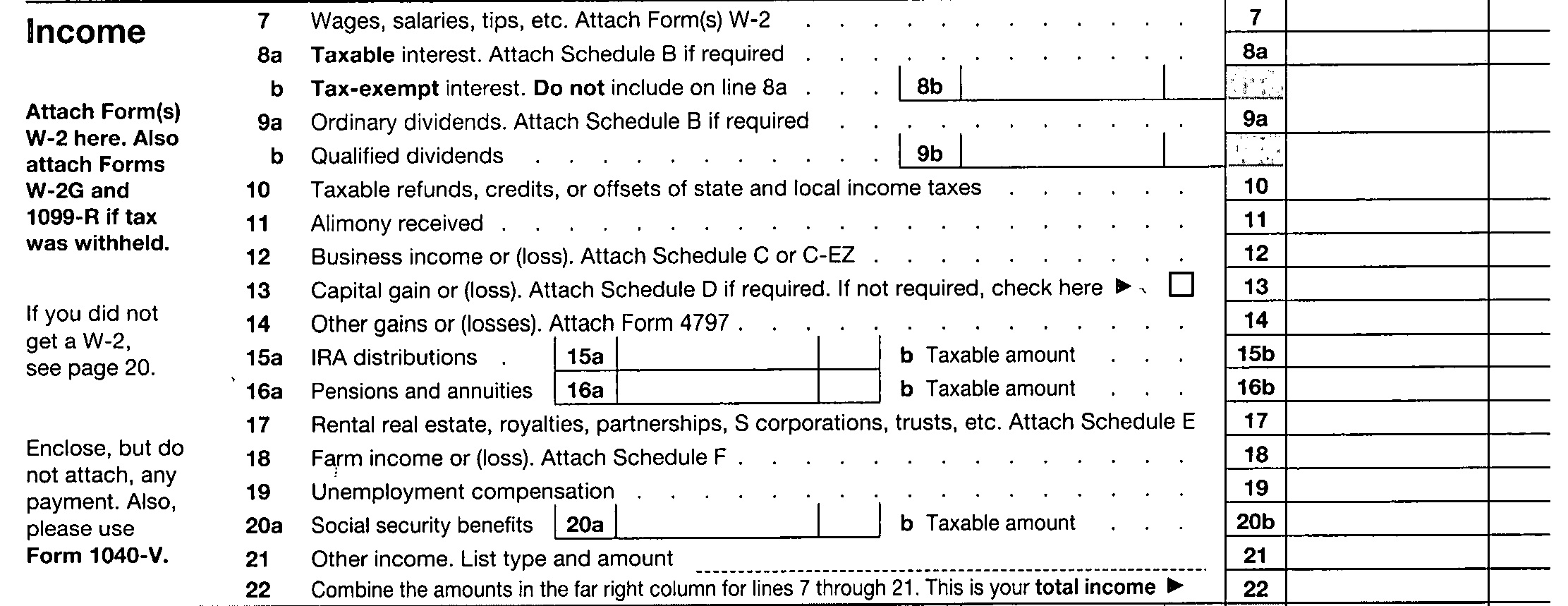
Although “gross” income is a term in the statute, but not the 1040, its context is made clear when reference is made to the calculation of Adjusted Gross Income which begins on line 23.Continue Reading "Gross (Total) Income" for the Purposes of Child Support and Temporary Maintenance

Calulator on 100s 2.jpgIn this second of two blogs discussing Supreme Court Nassau County Justice Anthony J. Falanga‘s March 28, 2011 decision in A.C. v. D.R., we look at the Court’s temporary financial relief rulings under the recent amendments to D.R.L. §§236B(5-a) and 237. Last Monday’s blog discussed the joinder for trial of the wife’s post-no-fault action with the husband’s pre-no-fault action, as well as the Court’s denial of the wife’s partial summary judgment motion on her no-fault claim, although the Court recognized no defenses were available to a subjective irretrievable breakdown claim.

The parties were married in 1992 and have 3 children, ages 13, 10 and 7. The parties continue to reside in the marital residence.

The husband, a 52-year old physician, had 2009 earnings of $530,645.00, although the Court noted that he has $15,833.00 in monthly gross W-2 income from private practice. The wife, a 46-year old homemaker, had $8,516.00 in 2009 dividend income.

At the Preliminary Conference, the husband stipulated to pay the marital residence realty taxes (there is no mortgage), gas electric, telephone including cell, water, homeowner’s, automobile, umbrella, medical and disability insurance, cable TV and Internet, alarm, domestic help, gardening and landscaping, snow removal, sanitation and exterminating, and in-network health expenses. The husband claimed the fixed expenses totaled $7,274.00 per month ($87,288.00 per year).

Based on its determination that the husband’s income net of FICA and Medicare taxes was $529,857.00, the Court first applied the new temporary support formula to determine that the presumptive temporary maintenance award would be $148,297.00 (30% of $529,857.00 minus $8,516.00, as that result is less than 40% of the parties’ combined income less the wife’s income). The Court, then, noted that blind adherence to this formula was likely to lead to inequitable results:

. . . [I]n this court’s view, the statute requires some remedial language as strict application in almost every case will not effectuate the statute’s purpose and will result in awards that are unjust and inappropriate . . . .

Continue Reading Court Tempers Temporary Maintenance Formula and Temporary Child Support with Reality Check

Calulator on 100s 3.jpg

The February 15, 2010 [sic] decision of Rockland County Supreme Court Justice Alfred J. Weiner in C.K. v. M.K., adds to what is shaping up to be a remarkable string of cases applying the 2010 temporary maintenance and counsel fee amendments to the Domestic Relations Law.  The decision was published March 15

Calulator on 100s.jpg

The March 15, 2011 decision of Westchester County Supreme Court Justice Francesca E. Connolly in Margaret A. v. Shawn B., raises a number of questions and invites lessons to be learned. Here, the Court applied the recently-adopted temporary maintenance and counsel fee statutes to a recently-terminated substantial wage-earner.

The parties were married in June

Divorce Agreementl.jpgIn its February decision in Fragin v. Fragin, the Second Department interpreted a 1995 separation agreement which survived the entry of the parties’ 1995 divorce judgment. Pursuant to that agreement, the ex-wife was obligated to contribute to the basic graduate school expenses of the parties’ unemancipated children. However, in fact and not surprisingly, at

Change Buttonl.jpgEffective October 14, 2010, amendments to D.R.L. §236B(9) and F.C.A. §451 go into effect (Laws 2010, chap. 182; Bill #A8952).  They require that language be included in divorce settlement agreements to specifically opt out of a newly-created entitlement to a judicial modification of a child support order. Without such language, even a child