1040.jpgThe Appellate Division, Second Department, has again told J.H.O. Stanley Gartenstein that it was improper for him to award nontaxable spousal maintenance.

In Siskind v. Siskind, in addition to awarding the wife $65,000 per year in nontaxable maintenance until the wife reached her 65th birthday, J.H.O. Gartenstein equitably distributed the parties’ assets, awarded child support and a $340,000 counsel fee, and secured the husband’s support obligations with a $4 million life insurance policy (reduced on appeal to $3 million).

In its November, 2011 modification of that award, the Second Department recognized the presumption that spousal maintenance should be taxable income to the recipient spouse, and deductible to the payor. The appellate court stated:

. . . there was insufficient evidence justifying the Supreme Court’s direction that maintenance be nontaxable to the plaintiff, which is “a departure from the norm envisioned by current Internal Revenue Code provisions.”

In 2007, in Grumet v. Grumet, the Second Department had modified J.H.O. Gartenstein’s award to the wife of non-taxable maintenance, declaring that in the absence of a stated rationale for a departure from the norm envisioned by the Internal Revenue Code provisions, a maintenance award should be taxable.

Maintenance is appropriately taxable income to the recipient. Baron v. Baron (2nd Dept. 2010), Markopulous v. Markopulos, 274 A.D.2d 457, 710 N.Y.S.2d 636 (2nd Dept. 2000) ; see also Taverna v. Taverna (2008), where the Second Department modified the trial court award by making maintenance taxable. Such may have been the holding because the trial court properly declined to consider the husband’s tax liabilities resulting from the liquidation and distribution of investment accounts incident to equitable distribution, as the husband had failed to offer any competent evidence concerning the liabilities which would be incurred. See Fleishmann v. Fleischmann (2010 Supreme Westchester Co., Lubell, J.)Continue Reading The Taxability of Spousal Maintenance Payments: a Subject of Inconsistent Court Decisions

Calulator on 100s 8 red.jpgOn October 25, 2011 the New York State Law Revision Commission held a round-table discussion to review New York’s spousal support, i.e. “maintenance” statute, Domestic Relations Law §236(B)(5-a, 6). The discussion precedes a final report which that Commission is required to render under a mandate imposed by the Legislature when new laws concerning temporary maintenance, interim counsel fees and no-fault divorce were adopted last year. In part, the Commission was charged to:

review the maintenance laws of the state, including the way in which they are administered to determine the impact of these laws on post marital economic disparities and the effectiveness of such laws and their administration in achieving the state’s policy goals and objectives of ensuring that the economic consequences of a divorce are fairly and equitably shared by the divorcing couple . . . .

Lee Rosenberg, chair of the Nassau County Bar Association Matrimonial Law Committee, noted that last week’s round-table discussion revealed a gap in opinions.  Those advocating for lower income women and domestic violence victims believed that the interim temporary maintenance statute enacted last year should remain in effect, with permanent guidelines leaving little to judicial discretion needed as well. The rest of the attorneys and judges believed a “one size fits all” formulaic approach did not work, created more litigation and did not do justice for both parties.

Mr. Rosenberg commented that if there was any majority view, it was that the temporary maintenance statute needed a major overhaul or complete repeal, except perhaps in lower income cases. Courts should retain real discretion to consider long-established factors in making any award, temporary or final.

A Preliminary Report on Maintenance Awards in Divorce Proceedings (Law Revision Report on Maintenance May 11 2011.pdf) was issued by the Law Revision Commission on May 11, 2011. That Report concluded that the 2010 temporary maintenance law sparked “intense debate over whether a formula should be used to calculate temporary maintenance.” To pursue its mandate, the Commission is reviewing reported appellate and trial court decisions awarding or denying temporary and/or final maintenance over the past 14 years. The Preliminary report presented a summary of the most recent decisions.

Posts in this blog on March 23, April 5 and July 18 considered recent awards under the new temporary maintenance statute, criticizing the absence of a “reality check” in two of those decisions.Continue Reading Spousal Maintenance Statute Difficulties Noted by New York's Law Revision Commission

Gay marriage rings.jpgLast week, the Appellate Division, Third Department, exercised its equitable muscle to filling in the gaps while the marriage and divorce laws of the different states catch up with each other.  On July 21, 2011, in Dickerson v. Thompson, the court granted a dissolution of a Vermont civil union.

Under Vermont law, the civil union entered by the gay couple was not a marriage. As a result, a New York divorce, “no-fault” or otherwise, was not the appropriate remedy. The appellate court noted that as “the plaintiff would be entitled to a dissolution of a civil union in Vermont,” but for her failure to be a current resident of that state. Giving the plaintiff her need relief, the court declared the broad equity powers of the New York Supreme Court were sufficient to declare the Vermont civil union dissolved. Thus, the plaintiff would now be free to marry, domestically partner, or re-unite with another.

While New York tore asunder one gay couple, more than 800 gay couples were able to marry on July 24, 2011, the first day of such unions under New York’s same-sex marriage legislation.  New York is still coming to grips with joining the rest of the country by making the dissolution of a marriage a matter of one spouse’s choice: a simple declaration that the marriage has broken down irretrievably. That law is just under 10 months old.Continue Reading Defining or Questioning the Marriage Contract: Gay Marriages, No-Fault Divorce and Dissolved Civil Unions

House of money.jpgThe May, 2011 decision of the Appellate Division, Second Department, in Many v. Many, seems, at first blush, to be a rather routine matter. While their divorce action is pending, the interests of the parties are balanced. However, below the surface lurk issues which highlight the frustration and anxiety which spouses must feel as their case is squired through the judicial process.
By Order to Show Cause issued June 13, 2009, two years before this decision, the wife sought interim support.  She also sought a restraint against her husband refinancing the marital residence. One may surmise that Mr. Many was sole owner of the home; it was his “separate property,” subject to his wife’s claim to an equitable share.

Ms. Many received her award of temporary maintenance. However, by his Order of April, 2010, Supreme Court, Westchester County, Justice Edgar G. Walker, denied that branch of Ms. Many’s motion which was to restrain her husband from encumbering the marital residence.  In effect, Mr. Many was authorized to refinance the equity in the marital residence, but restricted from using the funds for any purpose other than paying his pendente lite maintenance obligation.Continue Reading When Mortgaging the Marital Residence Is Necessary to Pay Temporary Support

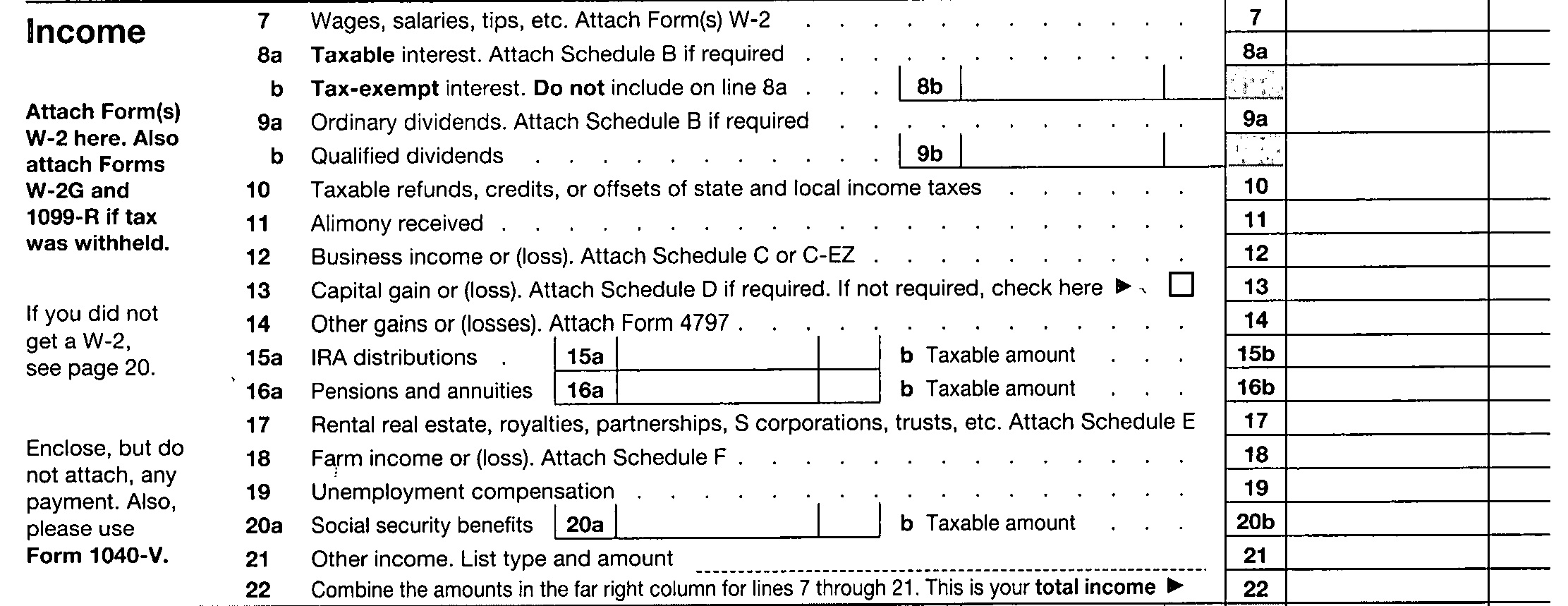
Have you looked at an IRS Form 1040 (pdf) lately?

Looking at the 1040 is supposed to begin the C.S.S.A. calculation for determining child support.  For actions commenced on or after October 13, 2010, it is also the first step when determining temporary maintenance. When computing child support under either the Family Court Act or the Domestic Relations Law, the calculation starts with a determination of parental income. F.C.A. §413(c)(1) or D.R.L. §240(1-b)(c)(1). Determining parental income under either F.C.A. §413(b)(5)(i) or D.R.L. §240(1-b)(b)(5)(i) begins by looking at the:

gross (total) income as should have been or should be reported in the most recent federal income tax return.

The recent amendment to D.R.L. §237(B) adopts the C.S.S.A. definition to begin the calculation of a temporary support award under D.R.L. §237(B)(5-a)(b)(4):

“Income” shall mean:

(a)  income as defined in the child support standards act . . . .

There actually is a line on the federal income tax return which reports the “total income.”  It’s line 22: Total Income.jpg

Although “gross” income is a term in the statute, but not the 1040, its context is made clear when reference is made to the calculation of Adjusted Gross Income which begins on line 23.Continue Reading "Gross (Total) Income" for the Purposes of Child Support and Temporary Maintenance

Calulator on 100s 2.jpgIn this second of two blogs discussing Supreme Court Nassau County Justice Anthony J. Falanga‘s March 28, 2011 decision in A.C. v. D.R., we look at the Court’s temporary financial relief rulings under the recent amendments to D.R.L. §§236B(5-a) and 237. Last Monday’s blog discussed the joinder for trial of the wife’s post-no-fault action with the husband’s pre-no-fault action, as well as the Court’s denial of the wife’s partial summary judgment motion on her no-fault claim, although the Court recognized no defenses were available to a subjective irretrievable breakdown claim.

The parties were married in 1992 and have 3 children, ages 13, 10 and 7. The parties continue to reside in the marital residence.

The husband, a 52-year old physician, had 2009 earnings of $530,645.00, although the Court noted that he has $15,833.00 in monthly gross W-2 income from private practice. The wife, a 46-year old homemaker, had $8,516.00 in 2009 dividend income.

At the Preliminary Conference, the husband stipulated to pay the marital residence realty taxes (there is no mortgage), gas electric, telephone including cell, water, homeowner’s, automobile, umbrella, medical and disability insurance, cable TV and Internet, alarm, domestic help, gardening and landscaping, snow removal, sanitation and exterminating, and in-network health expenses. The husband claimed the fixed expenses totaled $7,274.00 per month ($87,288.00 per year).

Based on its determination that the husband’s income net of FICA and Medicare taxes was $529,857.00, the Court first applied the new temporary support formula to determine that the presumptive temporary maintenance award would be $148,297.00 (30% of $529,857.00 minus $8,516.00, as that result is less than 40% of the parties’ combined income less the wife’s income). The Court, then, noted that blind adherence to this formula was likely to lead to inequitable results:

. . . [I]n this court’s view, the statute requires some remedial language as strict application in almost every case will not effectuate the statute’s purpose and will result in awards that are unjust and inappropriate . . . .

Continue Reading Court Tempers Temporary Maintenance Formula and Temporary Child Support with Reality Check

Calulator on 100s 3.jpg

The February 15, 2010 [sic] decision of Rockland County Supreme Court Justice Alfred J. Weiner in C.K. v. M.K., adds to what is shaping up to be a remarkable string of cases applying the 2010 temporary maintenance and counsel fee amendments to the Domestic Relations Law.  The decision was published March 15

Calulator on 100s.jpg

The March 15, 2011 decision of Westchester County Supreme Court Justice Francesca E. Connolly in Margaret A. v. Shawn B., raises a number of questions and invites lessons to be learned. Here, the Court applied the recently-adopted temporary maintenance and counsel fee statutes to a recently-terminated substantial wage-earner.

The parties were married in June

Blank Check iStock_000013161843XSmall.jpgWith the addition on August 13, 2010 of D.R.L. §170(7), making New York the 50th state to grant no-fault divorces, Governor Patterson also signed an amendment to D.R.L. §237. That amendment creates a rebuttable presumption that while a divorce action is pending, the “less monied” spouse shall be awarded counsel and expert fees and expenses