square peg1.jpgEntering open-court oral stipulations of settlement to a divorce action is treacherous.  It’s easy to miss something or be imprecise in language.

However, striking the deal while the iron is hot is a necessary part of matrimonial litigation.  Letting the parties walk out of the courthouse without putting the day’s agreement “on the record” may cost the parties their deal.  Emotions, particularly in divorce cases, often cause second (and hundredth) thoughts on settlement provisions.  Giving friends and family one more opportunity for input may likely undermine the day’s efforts.

However, there are reasons that the typical written settlement stipulation consumes scores of pages. The boilerplate and legalese so offensive to the public is the necessary consequence of the thousands of decisions which interpret the words found in or missing from decades of previous settlements or otherwise requiring attention in any final agreement.  Moreover, without reflecting on the written word, it’s easy just to miss things.

Take the recent Second Department decision in Zuchowski v. Zuchowski.  The parties’ oral in-court stipulation announced that “all joint bank accounts have been split to the mutual satisfaction of the parties and here and forward each party shall keep any bank accounts in their respective names . . .”

Continue Reading The Nature of 529 Education Savings Plans Should Not be Disregarded Under the Guise of Divorce Stipulation Interpretation

Peter_Pan_by_nk_title.pngAt age 18, the child becomes an adult, legally beyond the reach of parental decisions. However, not until age 21 does the legal obligation to support that child come to an end (unless extended by agreement).

A parent’s obligation to support may end (or be suspended) before that, as when a child marries, enters the armed forces, or becomes economically independent.  However, as a practical matter as long as the child remains under a parent’s roof, economic independence may not be found.

Take the June 28, 2011 of the Appellate Division, Second Department, in Smith v. Smith. There, the Court affirmed Suffolk County Family Court Richard Hoffman ‘s denial of a father’s objections to the order of Support Magistrate (and Pace Law School Professor) Cheryl Joseph-Cherry which awarded $200.00 per month child support to the wife/mother.

The parties’ son worked full-time. He paid for his own car insurance and cell phone.  However, the appeallate court found it persuasive that the mother still paid for his food, shelter, clothing, and health and dental insurance.

The decision does not provide greater detail. We don’t know what the child “does” or how much the child earns. Presumably, if the child is in school, we would have been told.

However, the Court did place primary reliance upon the First Department’s 2009 decision in Matter of Thomas B. v Lydia D. That decision, itself placed heavy reliance upon the Second Department’s decision in Matter of Fortunato v. Fortunato, 242 A.D.2d 720, 662 N.Y.S.2d 570 (1997). In Fortunato, the child was found to be emancipated because he was:

working an average of 30 to 35 hours per week … [,] he used his earnings to meet all of his personal expenses, including car insurance payments and telephone charges, and … he voluntarily contributed modest sums to his mother for room and board. Moreover, the son was not attending school, and had no plans to save money for tuition or return to college in the immediate future.

Continue Reading Child's Economic Independence, Not Full-Time Employment, Signals End of Support Obligation

Parenting Time Calendar checked off.jpgNo two custodial arrangements are the same. They are as different as the children and parents themselves. As a result, the application of a presumptive child support award to the “deemed” custodial parent is inherently arbitrary.

Take the May 5, 2011 decision of the Third Department in Riemersma v. Riemersma. The issues in the parties’ divorce concerning support of their twins had been referred to Family Court Support Magistrate Jonathan A. Heussi. The Magistrate determined in his October, 2009 order that the mother was the custodial parent.

The mother was a State Trooper working seven 7:00 p.m. to 7:00 a.m. shifts out of every 14 days. She earned $87,857 annually. The father, an urban forestry program manager, worked weekdays from 8:00 a.m. to 4:30 p.m. He earned $50,392 annually.

The parents crafted their parenting plan so that each parent would care for the children while the other was at work. Overnights were divided equally. However, because of the mother’s night-shifts, the court determined that the children spend 65% of the time with their mother. As a result, Magistrate Heussi’s finding that the mother was the custodial parent for C.S.S.A. purposes was affirmed a year and a half later in this appellate decision.

Strictly applying the C.S.S.A. formula would have resulted in the father paying $442 bi-weekly as his base support obligation. The magistrate had determined that such an award would have been unjust and inappropriate. Instead, he awarded the mother $200 bi-weekly.

With joint or shared arrangements the identification of the deemed custodial parent should be based upon the “reality of the situation.” The appellate court agreed the mother should be deemed the custodial parent. While a mechanical comparison of hours was not countenanced, the overall time spent with each parent was to be considered. Here, presumably because the mother worked while the children slept, she spent more time “with the children.”

The appellate court also approved the monetary result, but criticized the Magistrate for his reliance upon each parent’s need to maintain a suitable residence for the children. The “Support Magistrate failed to specify the factors relied upon to deviate from the presumptively correct child support amount or the extent, if any, of the expenses justifying such a deviation . . . . Indeed, at the fact-finding hearing, defendant testified that he had not incurred any unusual or extraordinary expenses related to the care of the children.”

Furthermore, we have previously held that the costs of maintaining suitable housing and providing food and clothing for the children during custodial periods do not constitute extraordinary expenses that would justify a deviation from the statutory formula.

Nonetheless, based upon the appellate record, the Third Department was able to determine that the application of the presumptive formula would have been unjust and/or inappropriate based the non-monetary contributions of the father and the fact that the father’s income was substantially less than the mother’s.

Continue Reading Applying the Child Support Formula in Shared Parenting Arrangements

We are not moving cropped.jpg

The May 5, 2011 decision of the Appellate Division Third Department in Munson v. Fanning, highlights the need for difficult discussions and prioritization before taking life-altering steps. It is also another call for the expanded use of the Collaborative Law Process.

In this case, the parties’ 12-year old daughter had been born after her parents had separated and divorced. The mother sought and permission to move with the child to California to join her new husband who had taken a new job. Saratoga Family Court Judge Courtenay W. Hall denied that relief, but revised the father’s visitation schedule to allow the mother to join her husband for extended periods during school recesses.

The appellate court reviewed whether the mother met her burden of proving by a preponderance of the credible evidence that the relocation was in the child’s best interests. Quoting the 1996 landmark decision of the Court of Appeals in Tropea v. Tropea, 87 N.Y.2d 727, 642 N.Y.S.2d 575, the court stated:

The factors to be considered in making such a determination include “each parent’s reasons for seeking or opposing the move, the quality of the relationships between the child and the custodial and noncustodial parents, the impact of the move on the quantity and quality of the child’s future contact with the noncustodial parent, the degree to which the custodial parent’s and child’s life may be enhanced economically, emotionally and educationally by the move, and the feasibility of preserving the relationship between the noncustodial parent and child through suitable visitation arrangements.”

The court recognized the healthy relationship the daughter developed the mother’s new husband, as well as her other children, all of whom were to reside in California. The step-father’s new job in California would allow her to stay at home and raise her children. The attorney for the daughter (formerly called the Law Guardian) supported the relocation.

Continue Reading Relocation to California Denied Mother with 12-year Old Daughter

scissors contract 2.jpgWhat happens when only one provision of an agreement is invalid because it violates some statute or public policy?  The answer may depend on who the court wants to benefit, instead of consistently-applied rules of contract law.

Take, for example the April 5, 2011 decision of the Second Department in Duggan v. Duggan.  In that case, the parties had resolved their divorce by a surviving February 26, 2009 stipulation of settlement. Under that stipulation, the father, who had gross income of $475,000.00, agreed to pay a base monthly child support obligation of $8,000.00.  That amount deviated from the presumptive amount under the Child Support Standards Act (C.S.S.A.) of $11,929.54. The mother had no income.

Apparently, the stipulation also had a provision which called for the reduction in the father’s monthly obligation in the event his income was reduced.

In 2010, the mother brought a Family Court enforcement proceeding when the father ceased making the payments to which he originally agreed. The father raised the stipulation’s modification provision, arguing that his $8,243.00 annual reduction in income to $466,757.00 entitled him to a $76,800.00 annual reduction in child support (to $1,600.00 per month)!

Finding that the father’s interpretation of the stipulation modification provision was “not plausible,” Nassau County Family Court Judge Julianne S. Eisman denied the father’s objections to the Order of Support Magistrate Tejindar S. Kahlon which granted the mother’s arrears petition. Finding that the language of the Stipulation, as interpreted by the father, would violate the C.S.S.A., and was against the best interests of the children, the modification provision was ignored.

On appeal, the Second Department affirmed, holding that the Family Court had the authority to find that a provision in a stipulation of settlement violated the C.S.S.A. The appellate court found that a provision which called for a reduction in child support to 13% of the presumptive C.S.S.A. amount, merely because the father’s income dropped by 1.7% was “against the best interests of the children.”

It is noteworthy that the appellate court did not quote the startling modification provision. Equally noteworthy is that there was no discussion of any interpretation of the modification provision other than the one the Family Court considered implausible.

In order to have obtained the Judgment of Divorce, it would have been necessary to have made the recitation in the stipulation of settlement that the parties had been made aware of the C.S.S.A. and its presumptive formula in their case. D.R.L. §240(1-b)(h).  The parties would have had to have stated the reasons they agreed to deviate from the C.S.S.A guidelines. Specific Findings of Fact would have been made by the Supreme Court upholding those reasons.

It is understandable that the presumed failure of the Supreme Court to review the specific modification provision might not estop the mother from later attacking that provision when it was sought to be applied. Thus, the form language of a divorce judgment that “the parties are directed to comply with every legally enforceable term and provision” of the agreement incorporated into the judgment, does not mean that every provision is, in fact, legally enforceable.

What then is, or should be the impact of rendering unenforceable only one provision of a settlement agreement?

Continue Reading Severability: When Only One Provision of a Divorce Settlement Agreement Is Invalid

name tag.jpg

There is perhaps no greater opportunity for courts to state their philosophies or to become instruments of social change than in cases involving the surnames of children of divorced and unmarried parents.

Take the March 29, 2011 Second Department case of Matter of Eberhardt. In that case, Mariah, the now nine-year-old daughter of Michelle Esquenazi and John Eberhardt, was born out of wedlock.  At the time of her birth, Mariah’s parents had been in a committed relationship and for a number of years and lived together with the mother’s three children from a prior marriage. Mariah’s birth certificate reflected the sole surname of her father. The father had acknowledged paternity. The parties’ intended wedding never took place. Approximately 1½ years after the child’s birth the father moved out. The mother maintained physical and legal custody, and the father visited regularly in accordance with an arrangement sanctioned by the Family Court.

In 2008, Ms. Esquenazi petitioned to change the child’s surname to Esquenazi-Erberhardt. Nassau County Supreme Court Justice Karen Murphy conducted a hearing at which the parties disputed the extent to which the father had been made aware that the child had been using the hyphenated surnames since age 2, and the extent of his protests once the use was known. Justice Murphy denied the mother’s petition, crediting the father’s testimony. Justice Murphy found that the objections of the father, who was emotionally and financially a part of Mariah’s life, were reasonable. The name change, Justice Murphy ruled, benefited the mother, not the child. To rule otherwise would reward the mother for her self-help and her knowing violation of the proper procedures for a name change under Civil Rights Law §§60 through 63.

A Second Department panel of three women and one man reversed, holding the father’s objections were not reasonable. Rather, his objections were raised to teach the mother a lesson. Moreover, the benefits to the child would not be denied simply to punish the mother for her self-help. Distinguishing the cases in which a mother was seeking to change the child’s surname to that of the mother, eliminating the father’s surname, the Second Department disagreed with Justice Murphy, and held:

[T]he emotional and financial involvement of the father is not a bar to a change to hyphenated surnames.

Continue Reading Changing the Name of the Child of Divorced or Unwed Parents

Fill in dot form.jpg

August 1, 2011 update: For a report on the status of the use of this form, I pass on a communication received from Bruce J. Wagner, Esq., Chair, NYSBA Family Law Section: Please click www.nysba.org/OCAMemoReUCS111A2 to view the memo dated July 28, 2011 from Susan W. Kaufman, Esq., Counsel to OCA’s Matrimonial Practice Advisory Committee, with an important update on UCS Form 111A, pertaining to Erie, Kings, New York and Onondaga Counties.


Original Blog:

In order to obtain a Judgment of Divorce in New York (Manhattan) and some other counties, effective April 1, 2011 (see Notice [pdf]), a new form is required to be submitted along with the proposed Judgment, Findings, and other papers.

That form, UCS-111A (pdf), replaces the UCS-111 (pdf) in some counties.  The form, itself, lists its applicability in Albany, Bronx, Erie, Jefferson, Kings, Nassau, New York, Onondaga, and Westchester Counties for each final order granted pursuant to Article 4 (support) or 5 (paternity) of the Family Court Act and in matrimonial actions under D.R.L. §§236B (property, support and special relief), 240 (custody and child support) and 246 (inability to comply with financial orders).  The older UCS-111 continues to be used in other counties.

The Unified Court System is required by law to collect various data concerning divorce proceedings. The form, itself, notes its basis under Judiciary Law §216 which provides at subd. 4:

The chief administrator of the courts shall collect data in relation to the number of cases in which the basic child support obligation, as defined in section two hundred forty of the domestic relations law and section four hundred thirteen of the family court act, was ordered; the number of cases in which the order deviated from such basic child support obligation and the reasons therefor; the incomes of the parties; the number of children, and the amount of child support awarded pursuant to the child support standards act; and amounts of alimony or maintenance, or allocations of property included in orders or judgments that include a provision for child support pursuant to the child support standards act . . .

It is noted that section 216(4) is scheduled to expires and be repealed pursuant to its own terms on September 1, 2011 (Laws of 1985, chapter 505, §5).

The confidential form does gather information which the parties to any divorce action should know before entering a settlement stipulation.  Thus, for example, the form asks for the occupation, annual income and health status of both spouses, the value of property divided and not divided, the amount of financial obligations outside of the divorce awards, the financial details and disposition of the marital home, and information concerning the division of professional degrees and licenses.  Awards of maintenance and child support are also detailed.

The form is reminiscent of public school standardized tests, with instructions to completely fill in the provided circles. In New York County, the forms are available in the Matrimonial Support Office, Room 311 at 60 Centre Street.

Only original forms UCS-111A may be used.  Each form has an individual serial number.

Reciting the requested information in the settlement would show that its terms were more knowingly entered.  The recitation should also facilitate post-judgment modification and enforcement litigation.

Indeed, the form should be completed, signed or otherwise acknowledged by the parties and appended to or referenced by settlement stipulation.  It certainly should not be left to counsel for one party to complete the form without using an agreed-upon statement of facts.

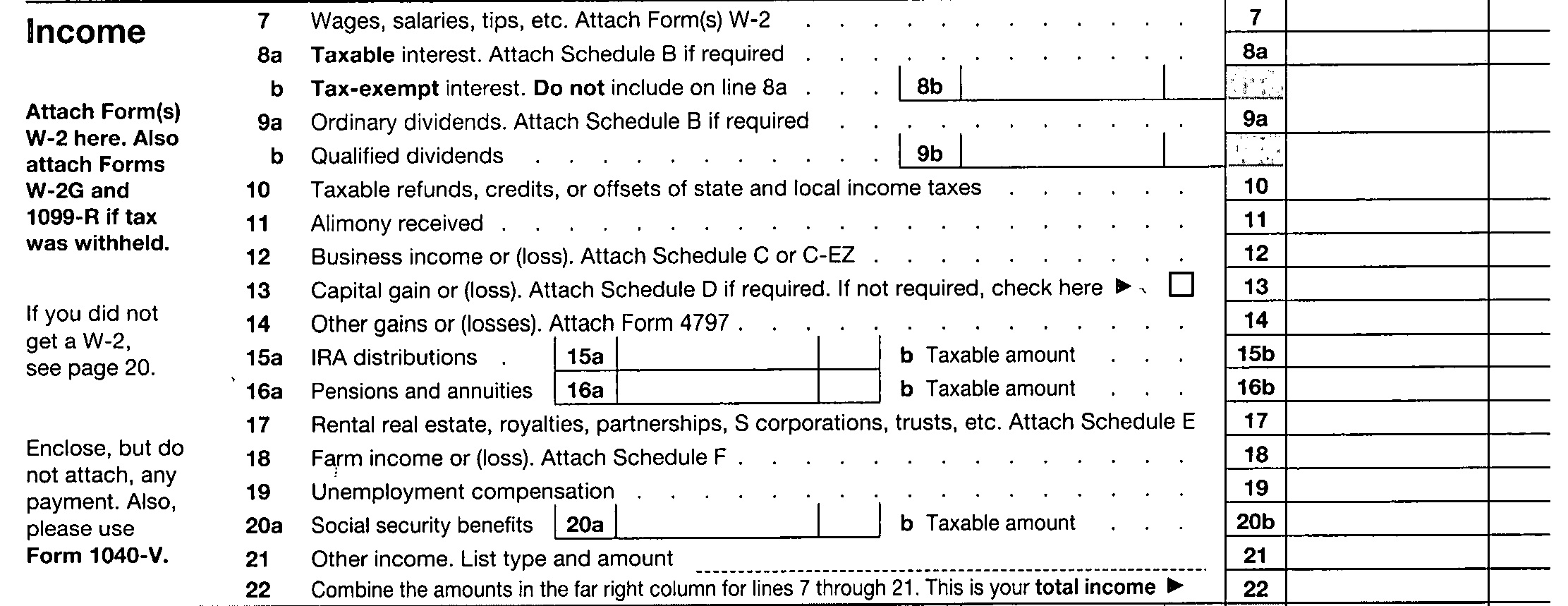
Have you looked at an IRS Form 1040 (pdf) lately?

Looking at the 1040 is supposed to begin the C.S.S.A. calculation for determining child support.  For actions commenced on or after October 13, 2010, it is also the first step when determining temporary maintenance. When computing child support under either the Family Court Act or the Domestic Relations Law, the calculation starts with a determination of parental income. F.C.A. §413(c)(1) or D.R.L. §240(1-b)(c)(1). Determining parental income under either F.C.A. §413(b)(5)(i) or D.R.L. §240(1-b)(b)(5)(i) begins by looking at the:

gross (total) income as should have been or should be reported in the most recent federal income tax return.

The recent amendment to D.R.L. §237(B) adopts the C.S.S.A. definition to begin the calculation of a temporary support award under D.R.L. §237(B)(5-a)(b)(4):

“Income” shall mean:

(a)  income as defined in the child support standards act . . . .

There actually is a line on the federal income tax return which reports the “total income.”  It’s line 22: Total Income.jpg

Although “gross” income is a term in the statute, but not the 1040, its context is made clear when reference is made to the calculation of Adjusted Gross Income which begins on line 23.

Continue Reading "Gross (Total) Income" for the Purposes of Child Support and Temporary Maintenance

Calulator on 100s 2.jpgIn this second of two blogs discussing Supreme Court Nassau County Justice Anthony J. Falanga‘s March 28, 2011 decision in A.C. v. D.R., we look at the Court’s temporary financial relief rulings under the recent amendments to D.R.L. §§236B(5-a) and 237. Last Monday’s blog discussed the joinder for trial of the wife’s post-no-fault action with the husband’s pre-no-fault action, as well as the Court’s denial of the wife’s partial summary judgment motion on her no-fault claim, although the Court recognized no defenses were available to a subjective irretrievable breakdown claim.

The parties were married in 1992 and have 3 children, ages 13, 10 and 7. The parties continue to reside in the marital residence.

The husband, a 52-year old physician, had 2009 earnings of $530,645.00, although the Court noted that he has $15,833.00 in monthly gross W-2 income from private practice. The wife, a 46-year old homemaker, had $8,516.00 in 2009 dividend income.

At the Preliminary Conference, the husband stipulated to pay the marital residence realty taxes (there is no mortgage), gas electric, telephone including cell, water, homeowner’s, automobile, umbrella, medical and disability insurance, cable TV and Internet, alarm, domestic help, gardening and landscaping, snow removal, sanitation and exterminating, and in-network health expenses. The husband claimed the fixed expenses totaled $7,274.00 per month ($87,288.00 per year).

Based on its determination that the husband’s income net of FICA and Medicare taxes was $529,857.00, the Court first applied the new temporary support formula to determine that the presumptive temporary maintenance award would be $148,297.00 (30% of $529,857.00 minus $8,516.00, as that result is less than 40% of the parties’ combined income less the wife’s income). The Court, then, noted that blind adherence to this formula was likely to lead to inequitable results:

. . . [I]n this court’s view, the statute requires some remedial language as strict application in almost every case will not effectuate the statute’s purpose and will result in awards that are unjust and inappropriate . . . .

Continue Reading Court Tempers Temporary Maintenance Formula and Temporary Child Support with Reality Check

Falanga.jpgIn his March 28, 2011 decision in A.C. v. D.R., Supreme Court Nassau County Justice Anthony J. Falanga gave full effect to New York’s new no-fault divorce law and temporary financial relief amendments.

In this first blog of two parts, the Court’s joinder of the wife’s no-fault action with the husband’s pre-no-fault action will be considered, together with the denial of the the wife’s motion for partial summary judgment on her no-fault grounds.  Although holding there is no defense to a no-fault claim, the Court declared that summary judgment and bifurcation of grounds issues are inapproriate.

Wednesday’s blog will consder the financial awards granted under the recent D.R.L. amendments.

The parties were married in 1992 and have 3 children, ages 13, 10 and 7. The husband, 52, is a physician; the wife, 46, a homemaker.

The husband commenced his divorce action on July 27, 2010 on the grounds of constructive abandonment and/or cruelty, although the wife was not served until October 22, 2010 (well within the 120 days of filing needed for timely service). However, four days before such timely service, the wife filed her own Summons with Notice, commencing an irretrievable-breakdown divorce action under D.R.L. §170(7) [effective October 13, 2010].

Earlier in this case, Justice Falanga resolved by January 18 Order, the husband’s motion to consolidate the two actions. The wife opposed on the grounds that if her action was subsumed within the earlier action, she would be prejudiced by her inability to avail herself of the new financial statutes. Represented by Robert Broderick, Esq., the wife argued instead for joinder for trial under C.P.L.R. §602(a), leaving the two actions intact, yet bringing the two actions together in one venue for pretrial and trial proceedings.

Justice Falanga noted that by joining the cases, as opposed to consolidating them, the husband would preserve his earlier commencement date for Equitable Distribution purposes, yet the wife would be entitled to relief under the later-enacted amendments to D.R.L. §§236B(5-a) and 237. In its January 18 Order, the Court granted a joint trial and joint discovery, after a bifurcated immediate grounds trial.

However, before that trial, the wife moved for partial summary judgment to establish her no-fault grounds as well as for interim financial relief.

In its March 28 Order, the Court re-analyzed the issues addressed in its January 18Order, denied partial summary judgment and canceled the grounds trial. In doing so, Justice Falanga gave true meaning to the no-fault nature of New York’s new divorce ground.

. . . [A] plaintiff’s self-serving declaration about his or her state of mind is all that is required for the dissolution of a marriage on grounds that it is irretrievably broken. . . . In adopting no-fault divorce, the Legislature implicitly recognized that the parties to a marriage should be able to make personal and unavoidably subjective decisions about the continuation of their marriage partnership.

. . . .

Therefore, in this court’s view, the Legislature did not intend nor is there a defense to DRL § 170(7).

Denying partial summary judgment, Justice Falanga also gave full import to the second sentence of D.R.L. §170(7), which provides that “no judgment of divorce shall be granted” until the custody and financial issues have been resolved. Such, the Court held, precludes the granting of summary judgment.

Continue Reading Court Recognizes There Is No Defense to No-Fault Divorce, But Withholds Summary Judgment